
Imagine having to walk 100 yards or more just to get to the front door of your high-rise apartment complex.
Imagine doing that all year long, rain, snow, sleet or shine. Imagine doing that with a carload of groceries, laundry or children.
Imagine doing that with no streetlights at night. Imagine doing that in one of the most crime-ridden communities in America.
Imagine doing that and nobody caring enough to make things safer or better.
The term “poverty tourism” has been around for hundreds of years, from “slum tours” being conducted in the States and London back in the 1800s, to organized group outings to “experience” the effects of apartheid in South Africa in the 1980s.
Also referred to as “trauma tourism”, this shameful act of classism and racism is still a strong business venture in countries across the globe.
The voyeuristic nature of the practice, allowing people to view squalid living conditions and “getting a taste” of what economically forgotten communities deal with daily from the safety of a tour bus or online video, has played a role in horror cinema since practically the beginning, as well.
Films like 1943’s I Walked with a Zombie, 1974’s Texas Chainsaw Massacre and 1991’s The People Under the Stairs allowed viewers a look into a lifestyle or society they may have never even knew existed. Impoverished individuals whose financial status seems to automatically put them in the “suspicious characters” bin, families driven to horrific rage and desperation with the advancement of technology and corporate greed, systemic racism roiling under the white picket fences of the good ol’ U.S. of A.
These are films that use their lower class setting as not just oppressive set pieces but integral characters in and of itself. Oftentimes, this setting also lends itself to lax police support and neighborhood violence that you certainly wouldn’t except in an idyllic Norman Rockwell US town.
More recently, Don’t Breathe, Barbarian and It Follows show some of the lower income working class life of American suburbia. Characters’ decisions are, at times, based solely on their surroundings or social situation that may require them to scrape by or, in the case of Don’t Breathe, steal to survive. Barbarian, much like director Zach Cregger’s sophomore hit Weapons, is set in a town that once had promise but seems to now be fading away as a forgotten suburb. Buildings are crumbling, the residents are living paycheck-to-paycheck, this is the America most of us know and live in. It Follows probably grounds itself in this almost seedy “poverty tourism” vibe more than any other recent film, if you ask me.
There is, arguably, no film that allows its urban landscape to breathe and haunt better than 1992’s Candyman. The film is groundbreaking in several ways, not the least of those reasons being the shot-on-location spotlight placed upon the Cabrini-Green projects in Chicago. The supernatural terror of a hook-wielding phantom hellbent on vengeance pales in comparison to the real-life horrors, trauma and oppression of public housing. The two mix beautifully, tragically and poetically, to create one of the greatest horror films of all time.
I remember watching Candyman and feeling a great sense of unease about the projects that they showed- stairways that seemed to stretch forever. Dark halls that abandoned apartments that seemed to be just a small compartment in a labyrinthian hellscape- how the hell was anyone supposed to get out of there?
It intrigued me so much, in fact, that I started doing my own research with the best source of true crime and horror intelligence I could ever ask for- my mother.
She told me how apartments would be left to rot in squalor after a resident moved out or was killed, the residence quickly taken up by gang activity or homeless individuals in the area. She re-watched the scene where Helen literally climbs out of the gaping mouth of what appears to be the Candyman with me and that’s when she told me about the medicine cabinets.

The Frances Cabrini Rowhouses were constructed in 1942, with the Cabrini Extensions being built in 1957. The William Green Homes were put up last, in 1962. Over the course of the next thirty-three years, The Cabrini-Green Homes loomed large over Chicago’s history, rarely for good reason.
These projects consisted of a staggering 3,607 units that housed a reported 15,000 people at the height of their occupancy rate. Some informal reports and surveys have suggested there were nearly 20,000 people living on-site at the peak of the properties’ existence.
Shortly after World War II, local establishments closed and public services nosedived in the area. To keep maintenance costs down, the lawns of Cabrini-Green were paved over and “minor issues” such as streetlights being broken, apartment appliances not working, bathrooms leaking and snow removal needs were tended to on an infrequent, if not completely non-existent, schedule. Pest and rodent infestation were overwhelming and reports of garbage chutes being clogged up to the fifteenth floor in the projects were confirmed by officials during investigations and inspections.
The exterior of the building was largely surrounded by chain link fencing, including on upper floor balconies. The balcony fencing was applied to keep residents from throwing trash over the balcony or falling as most balconies were rather poorly constructed. Of course, what this really did was simply alienate residents further from the outside world and make the project look like a prison yard.
Like any business opportunities or hope for a future around the buildings, the structures themselves began to deteriorate rapidly. While not the largest project in Chicago, the term “Cabrini-Green” became the national label applied to any low-income housing across the country. You didn’t have to live in Chicago to know about Cabrini-Green, but if you had the misfortune of living in Cabrini Green, you were forced to know no longer way of life.
Former Chicago mayor Jane Byrne famously “moved” to Cabrini-Green for a little less than three weeks in 1981 to put a spotlight on the real-life horrors that the state and nation seemed to be ignoring. Byrne proceeded to shut down local liquor stores and execute evictions on nearly 800 tenants who were suspected of gang activity in the buildings. The move was seen as an act of civic duty and a demand for equality by some and a poorly executed publicity stunt by others, but the fact remained- this was a place that was practically its own universe, with its own ecosystem, way of life and code of ethics.
The residents who called Cabrini-Green home were the victims of horrific living conditions and societal oppression that they simply had no way to get out from under.
As the buildings began to be demolished in the mid-90’s and gentrification began settling in, a whole other talking point (and one that the 2021 spiritual sequel Candyman takes on exceptionally well) only added scar tissue to the wounds of Chicago’s society.
I can’t possibly cover all Cabrini-Green’s tragic history here, but I highly recommend everyone do a little extra online digging and learn about just how terrible life in these projects were.
Beyond Cabrini-Green, other projects were built throughout Chicago and the nation, including the Gracie Abbott Homes, that shared similar fates of buildings decaying as quicky as the community around it.
A shameful failure by local and national government alike, these homes were anything but the safe havens that these residents deserved. This brings me back to the story of the medicine cabinets that my mother told me, and of the tragic death of Ruthie Mae McCoy.

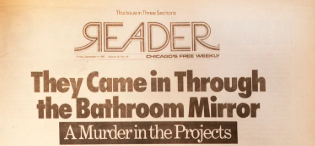
The story of Ruthie May McCoy’s death is one that has haunted Chicago for decades, and rightfully so. Chicago’s free publication, ‘Reader’, released a detailed essay on the victim titled “They Came in Through the Bathroom Mirror- A Murder in the Projects”, on September 3, 1987. Written by Steve Bogira, an esteemed journalist who made a career of speaking up for the disenfranchised, the piece is absolutely riveting. While this publication did a great job of telling the story, it’s important to note that Chicago’s black-owned “Defender” publication was the first group to tell Ruthie Mae’s story of injustice, with far less attention.
52-year-old Ruthie Mae McCoy was murdered after intruders entered her apartment through her bathroom mirror. McCoy called police and quite clearly explained what she was dealing with, but McCoy was failed by multiple systems, namely the police and housing authority.
On April 22, 1987, Ruthie called 911, insisting that someone was trying to break into her eleventh-floor apartment through the bathroom mirror. The audio recording of the call is upsetting to listen to, and Ruthie can be heard telling the dispatcher that someone “throwed the cabinet down”, referring to the medicine cabinet in her bathroom. The poor woman even went so far as to assure the dispatcher that the elevator was working, something that was such a rarity in the building that Ruthie knew it’d be worth noting to the police.
Neighbors reported gunfire that night, as well, but Ruthie’s call was considered as little more than just another problematic resident of the projects ranting and raving.
Shameful excuses were given as to why Ruthie wasn’t offered a better chance at surviving or at least having a more dignified ending, including property management claiming they couldn’t find their key to her apartment and police insisting they didn’t have a right to enter the apartment. Please note that racial discrimination and police-on-resident crime is not something to dismiss here. Reports on Ruthie’s mental health history were also released quite quickly.
Ruthie’s apartment wasn’t entered until two days after she called the police.
What happened that night seemed to be fairly cut and dry, albeit heartbreaking and terrifying.
Police arrived at Ruthie’s door about twenty-five minutes after she made the call. They beat on her door; they called her name. Nothing. When they asked the dispatch to call Ruthie’s number, they could hear the phone ringing, but no one answered. The officers wondered if somebody was possibly holding Ruthie hostage in the apartment. This is around the time when the property manager either gave the police the wrong key to enter the building or simply didn’t have a key to Ruthie’s residence. After wasting time asking neighbors if they’d heard anything (Rule #1 of living in the projects has always been not to snitch) and seemingly assuming that the woman who called police for help was now not answering her door even with her phone ringing inside the apartment, the police left about thirty minutes after arriving.
The next day, a concerned neighbor called in a wellness check for Ruthie. Police arrived again, this time with a few security guards from the high-rise. When the knocks and calls went unanswered again, the police considered knocking the door down. The property security guards advised against that- the resident might sue the police department or, even worse, the officers on the scene would have to stick around until the door could be repaired or secured once it was knocked down. Officers stunningly decided against entering the apartment. They left again.
The next day, the same resident who called for the wellness check, Debra Lasley, went down to the property office and raised her concerns. Only then did a project official and a carpenter arrive at Ruthie Mae’s apartment door to drill out the lock. Ruthie was found in her bedroom in a pool of her own blood, a victim of four gunshot wounds.
What makes this story especially upsetting is how the intruders gained access to Ruthie Mae’s apartment. It was a well-known issue in the building, and someone had tried to break into her apartment previously. The killers broke into the apartment adjacent to Ruthie Mae’s, tore down that apartment’s medicine cabinet and then crawled through the medicine cabinet in Ruthie Mae’s bathroom. The previous attempted break-in had rattled Ruthie Mae so much that she told people she was afraid of her bathroom. So much so, she resorted to using a bucket in a separate room rather than the toilet.
On the night of April 22, 1987, the criminals managed to get through into Ruthie Mae’s residence and shot her in cold blood, killing her with four bullets.
The project buildings were built with narrow spaces in between the walls of apartments to allow for ease of access for maintenance issues. On either side of these narrow spaces were openings where cheaply made medicine cabinets would be nailed up in each apartment, back-to-back to one another. The space between apartments was roughly two-and-a-half feet across and the cabinets were held up with little more than small nails. The decision to construct the buildings this way, for maintenance convenience, soon became a simple way for people to slip from apartment to apartment, usually with a criminal reason behind it. It was easy to pull down a cabinet in one apartment and then knock down the cabinet of the apartment across the maintenance crawlspace, which allowed for people to sneak through the complex, allude police or commit horrible acts of violence.
At the end of the day, Ruthie Mae was murdered right around the time she was planning on moving out of the projects. Ruthie had recently been granted Supplemental Security Income, as a part of the federal aid program for physically and mentally disabled individuals. She was approved for nearly $200 a month more than she had been getting, and the retroactive check that was sent to her was for nearly $2,000.
That sort of money would go a long way to helping get Ruthie into better housing, and so the woman did what anyone would do when they get a dash of good luck financially- she treated herself to some new clothes and a few other household items. One of these items, a 19” television, was seen being taken out of her apartment on the night of the murder by an alleged suspect. Police believe that a neighbor likely noticed Ruthie bringing home these new items and saw her as an easy robbery target.
Ultimately, two men were charged with the murder of Ruthie Mae McCoy but due to lack of evidence, particularly little to no cooperation from residents within the building, the charges were dropped after a lengthy trial.
Ruthie Mae’s daughter sued the Chicago Housing Authority for her mother’s death in 1988, to the tune of $1.5 million.
Reality and fiction intertwine every day, all around us, and most of the time it’s relatively mundane instances that hardly register as noteworthy. Sadly, there are other times where the horrors created in Hollywood directly mirror real-life heartache that citizens live with each day.
Some thirty-four years after the film’s release, Candyman still stands as one of the most unflinching and honest films steeped in the societal failures of the housing projects. The film also still bears a well-deserved demarcation that has yet to be resolved.
While the film Candyman is arguably one of the best horror films of all time, there’s one glaring failure that simply cannot be ignored. For all the insistence on setting a genuine tone for the film and even naming the very first victim of the movie Ruthie Jean, the film does not acknowledge or share an in-memorial during the end credits for Ruthie Mae McCoy.
I highly recommend the podcast, “Candyman: The True Story Behind the Bathroom Mirror Murder”, a 48 Hours Podcast. The series, hosted by Dometi Pongo, is an in-depth and brilliantly constructed listening experience that takes you through every dark hallway, nook and cranny of the infamous McCoy murder.
This is where you can hear director Bernard Rose defend his lack of acknowledgement with the McCoy family in his own words, a sad omittance on Rose’s part that does, in a heavy way, diminish his reputation in the eyes of this writer.
During an interview that Pongo navigates on a tightrope at times, as you can almost feel the director’s hackles raise, Rose claims he learned about the murder while scouting locations for the film he was working on. He states he was never taken to the Grace Abbott building, where the murder of Ruthie Mae took place, but he was given a tour of Cabrini-Green. A resident of the building spoke with Rose while he was walking the property and insisted that there were ghosts within the walls, thus inspiring the filmmaker to lean hard into the atmospheric horror rooted in the real-life projects.
While at dinner with a tenant of the projects, Rose was informed of the medicine cabinet disturbance and figured using that in the film would allow for the project to remain grounded.
Rose states that the McCoy murder was not an inspiration in any way for the film, rather the medicine cabinet urban legend was simply used as one plot point in the film. Rose claims he can’t recall if he read Steve Bogira’s haunting piece for The Chicago Reader, “They Came in Through the Bathroom Mirror”, and he’s been quoted as referring to Ruthie Mae McCoy as “whatever the lady’s real name was” when discussing the similarities between the film and the McCoy murder. A slip of the tongue, most likely, but as most people have pointed out during this discussion and debate over the years, Ruthie Mae was a real person whose murder can easily be perceived as being glamorized for the sake of box office success. It’s not a good look for a filmmaker who, otherwise, did a masterful job constructing one of the most famous horror films of all time.
When pressed on whether naming a character Ruthie Jean was based on his knowledge of the Ruthie Mae story, Rose admitted, “it probably was, yeah.”
The character Anne Marie in the short story ‘The Forbidden’ doesn’t have a last name. In the film, her last name is McCoy.
Rose’s insistence that the film isn’t about Ruthie Mae’s murder doesn’t make it any less difficult to rationalize that he seemingly is using her death as a plot point or, at the very least, a buzz topic for the film.
With all said and done, the film celebrates its thirty-fifth anniversary next year. I feel you simply cannot honor a work of art, this film that brought a whole new perspective of horror story-telling to the masses, without first and foremost honoring the real-life horrors that have never had a proper voice to speak for its victims.
Leave a Reply