
It was 1917 and the world was undergoing massive changes, to say the very least. Russia overthrew Czar Nicholas II, setting the stage for revolution and a civil war. The U.S. declared war on Germany, prolonging World War I. The names Pancho Villa, Vladimir Lenin, Benito Mussolini and the harrowing truth about shell shock dominated the news. Swedish Prime Minister Hjalmar Hammarskjold resigned over Sweden’s involvement in World War I, while Jeannette Pickering Rankin took her seat as the first woman elected to U.S. Congress, representing Montana.
It was a time in history where anything seemed possible, including magic.
In Cottingley, England, there were certainly much larger issues and concerns on hand at the time, but a series of photos ultimately captured the imagination of a country. Soon, the world would have their opinions, as well.
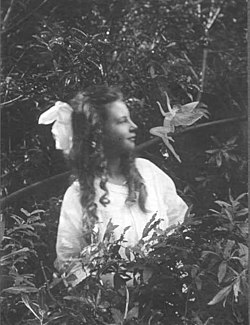
Two young cousins, Elsie Wright and Frances Griffiths, had an affinity for nature and enjoyed spending their days outside near their home’s stream. This messy endeavor usually resulted in upsetting at least one of the parents of the house, and one day, the girls claimed the only reason they visited the water was to “see the fairies”. Convinced they could show their parents that they were telling the truth, the girls borrowed a camera and disappeared back to the “beck” where they supposedly encountered the ethereal beings.
Arthur Wright, Elsie’s father who owned the camera, agreed to develop the photos the girls took in his own personal darkroom and was hardly stunned to see his niece, Frances, surrounded by fairies in one of the photos. He almost immediately brushed them off as fake, understanding the art of photography and sure that the lilliputian characters were drawings of some sort. The girls’ excitement ultimately wound down and Arthur didn’t think much more of the incident.
Some time later, the girls used Arthur’s photo again, this time producing a photo of Elsie holding a fairy in the pal of her hand. Arthur didn’t seem amused at all by the prank a second time and the issue was brought up to Polly, Elsie’s mother. Naturally, Polly was sure the photos were real, thus prompting more familial strain regarding the subject.
Two years later, Polly attended a Theosophical Society meeting in which the topic of the evening was “fairy life”. Eager to show what she believed was proof of fairies, Polly brought the two photos with her and showed them to the audience. The photos were soon shared during the annual Society’s conference, as a core belief of theosophy consists of the belief that humanity is constantly evolving. Thus, many within the circle believed that the girls had genuinely captured a relic of lost time, a small group of humans who had yet to evolve into the more natural state of the species at the time.
Just as soon as there were believers, there were skeptics, however the story continued to gain traction as factual when photography experts confirmed that there was no manipulation or editing found on the negatives or the photographs themselves. Harold Snelling, the first to examine the photos, stated that “these are straight forward photographs of whatever was in front of the camera at the time.” It’s important to note that Snelling didn’t, nor did he ever, state that he believed what the photos showed were actual fairies.

The photos became so well-circulated, in fact, that Sir Arthur Conan Doyle looked to use them in a Christmas article he was working on for a popular short fiction publication in the United Kingdom. Naturally, the photos were quickly being reproduced and sold by several people at many different lecture halls whenever discussing the fairy phenomenon. Doyle went so far as to write to Elsie and her father, Arthur, asking permission to use the photos for his magazine submission.
The photos fascinated Doyle so much that he ended up seeking further opinions from the long-standing photography company, Kodak. Upon inspection of the photos, Kodak never confirmed the veracity of the claim that the photo, in fact, showed real fairies.
As interest in the story grew, so did the scrutiny and requests to talk with the girls responsible for producing the photos. Skeptics wanted to see the fairies for themselves and believers wanted more photos. The girls claimed that the fairies wouldn’t show themselves to anyone but the two of them. As the attention grew, the girls ended up producing three more photos with the fairies.
Regardless of how many photos were handed over to experts as proof, non-believers persisted.
So, if these weren’t real fairies in the photos, what were we looking at? Surely, technology was still in its infancy as far as photo editing at the time, especially for two young girls in the English countryside. One gentleman who looked the photos over believed them to be dancers dressed as fairies, with the photos doctored to show the creatures as much smaller than they really were. Several others believed the mythological beings to be nothing more than drawings adhered to cardboard that would allow them to stand up for posing.
Perhaps, in a time of world history where there was so much strife, resentment and anxiety, the idea of magic being real was something people found easy to reach for. While the papers were packed with stories of death, upheaval and injustice across the globe, Doyle’s piece in The Strand Magazine titled “Fairies Photographed” helped the publication sell out in record time. Doyle was a Spiritualist in his personal life, and had no reservations about believing in these fairies. In Doyle’s words, if the public accepted fairies, they could “admit that there is a glamour and mystery to life”, which was a mindset that would have fit in nicely with his Spiritualistic beliefs.

Coverage of the story upon publication ranged from wonder and awe to frustration and mockery. Many attributed the photographs to the work of two young ladies with overactive imaginations. Again, in a time when “the real world” was suffocating everyone at every turn, perhaps some people were trying to hard to turn a child’s creativity into something more.
As the years past, the search for answers continued. Nearly fifty years after the photos were taken, Elsie conceded that the fairies in the photos “may have been figments of my imagination”. Several years later, Elsie maintained her stance that the photographs were merely imagination art. However, a few years later, when Elsie was paired with Frances for an interview, both ladies denied having fabricated the photographs.
As technology evolved, so did the methods of investigating the photos. The photographs were processed through computer enhancing programming and the Committee for the Scientific Investigation of Claims of the Paranormal confirmed that strings could be seen holding the ‘fairies’ upright.
Then, in 1983, the cousins confirmed that four of the five photos were faked. While they still insisted that they’d seen fairies, Elsie stated that she copied illustrations from a popular children’s book onto cardboard and added wings to the tiny dancers in the artwork. The drawings were cut out, and held in place by hatpins. The fifth photo, which did not include a girl and is known as “Fairies and their sun-bath”, was real, Frances insisted. Ultimately, the girls admitted that they kept the story going because they were too embarrassed to tell the truth, especially after Doyle became a part of the larger story. Frances went on to say, “I never even thought of it as being a fraud- it was just Elsie and I having a bit of fun.”

In Frances’ later years, she wrote to Elsie that she “hated” the photographs and seemed to know fairly early on “what I was in for if I did not keep myself hidden”. The spotlight of the world prompted a resentment within the ladies at different times of their lives.
Prints of the photographs have fetched a hefty sum at auctions over the years, and the fascination with the story continued well after the passing of Frances, in 1986, and Elsie, in 1988. Frances’ daughter brought one of the camera used to take the photos, along with the photos to a filming of an episode of ‘Antiques Roadshow’ where it was believed the items could be sold for upwards of thirty thousand pounds, roughly $40,400 in US currency. Frances’ memoirs were published in 2009 and included the letter from Frances where she confirmed her hatred of the photos and the fervor they brought on.
In 1997, the film Fairy Tale: A True Story was released. This was the first time I’d learned of the story, as my sister was quite enamored with it. Over the course of a year or two, I was subjected to the film several dozen times but admittedly, found the story to be quite compelling. I went on to do my own investigation into fairies at the age of eleven and quickly decided that fairies were real, humans probably just couldn’t see them. Twenty-nine years later, I think the basic stance remains the same, although the reasons behind humans not being able to see any sort of magical being are a bit more detailed than they were back then. But that’s a story for another time.

Leave a Reply