
I first saw Candyman when I was in the sixth grade, at a sleepover. I was a reluctant participant in the sleepover, having dealt with a ton of bullying that year by a number of classmates, including the kid who randomly invited me over to his house to spend the night on one boring Saturday.
Against better judgment, I asked my parents if I could go and there seemed to be hope within my house that this would lead to things getting better for me that school year. Spoiler alert- they did not, but I got to see one of my favorite movies of all-time, for the first time that night. For that, I am forever grateful.
When we grew tired of thumbing through comics and flipping through football cards, Ryan L. asked me if I wanted to watch a scary movie. Unbeknownst to Ryan, I was born in the darkness of horror films so I was skeptical that he had anything that would intrigue me. It turns out, he didn’t but his mother had rented a movie a few nights earlier and it was “supposed to be super scary, dude. Like, crazy scary.” I’ll always remember that description of Candyman.
So, we turned off the lights in Ryan’s basement, put a plate of microwaved pizza rolls between us and started the movie. About halfway through, Ryan suggested the movie was slang for a sexual preference that I never thought proper to use, and he said he was going upstairs to watch TV. In the moment, I remember wondering if he was regretting inviting me over- maybe he was tired of pretending to enjoy hanging out with me. Perhaps he thought the movie really sucked and he’d rather be upstairs hanging with his mom and sister. Looking back- nah, he was scared as hell.
I sat down there and watched the rest of the movie by myself, enthralled with the cinematography, deeply unnerved by the soundtrack and completely sucked in to the story.
When I came upstairs about an hour later, Ryan asked me if I finished the movie. I said yeah and told him I thought it was “pretty cool”. He rolled his eyes and repeated his earlier sentiments. I wish I had the wherewithal to tell Ryan to cope a little less loudly!
When I finally got home the next morning, when my mom asked me how the sleepover went, the only thing worth talking about was watching Candyman. In typical fashion, my father raised his eyebrows and proclaimed it was wrong for Ryan’s parents to let us watch that movie without notifying my dad.
Mom, on the other hand, lit up like a macabre Christmas tree, asking how I liked it and we proceeded to do a crude play-by-play of some of the more horrific scenes in the movie. Horror was always our shared language, so while we talked excitedly in the kitchen about a blood-spattered nursery and one of the coolest scenes ever (I won’t spoil here), my dad undoubtedly was in the living room taking mental notes that I was never allowed at Ryan’s house again. No worries, there- I had no need to pretend to play Ryan’s fake nice game anymore. I saw the movie and ate all the pizza rolls. I win, Ryan.

Based on the 1985 short story “The Forbidden” by the one and only Clive Barker, director Bernard Rose brought the story to life with most of the nuts and bolts of the original story intact. The story focused a blood-spattered lens on England’s urban legends and class structure. The film, released nearly seven years later, shines a haunting light on American prejudice and societal failures. Rose did, however, shift the setting from Liverpool, England to the projects of Chicago. This also meant that the film simply wouldn’t work unless the majority of the film’s characters were, in fact, black. While race wasn’t a focal point of the story, Rose deliberately made it the point of the film.
Audiences watch as Helen Lyle (Virgina Madsen) begins doing research on urban legends as a graduate student at the University of Illinois-Chicago. Helen is introduced to the boogeyman story of Candyman. The story and rules of Candyman are simple- he’s a vengeful spirit who gruesomely dispatches anyone who says his name five times into a mirror. Helen, ever the skeptic, plays along and summons the tortured spirit along with her friend.
As Candyman doesn’t appear instantly, Helen rolls her eyes at the anticlimactic game and continues working on her paper, focusing on how the residents of the Cabrini-Green projects use the stories of Candyman to cope with injustices of all kinds faced each day. While having dinner with a professor who is well-versed in the Candyman tale, Helen learns that Candyman was an African American man named Daniel Robitaille. He was the son of a former slave and a renowned artist who was ultimately lynched for falling in love with, and impregnating, a white woman. The mob committed horrific atrocities to Daniel while killing him before burning him on a pyre that stood where the Cabrini-Green projects now stand.
The film begins to spiral when Helen goes to investigate a report that a boy was viciously attacked in a bathroom and she is accosted by a gang member with a hook. When Helen goes down to the police station to identify the perpetrator, police recognize the man she picks as the head of a gang and decide to charge him with the Candyman Murders.
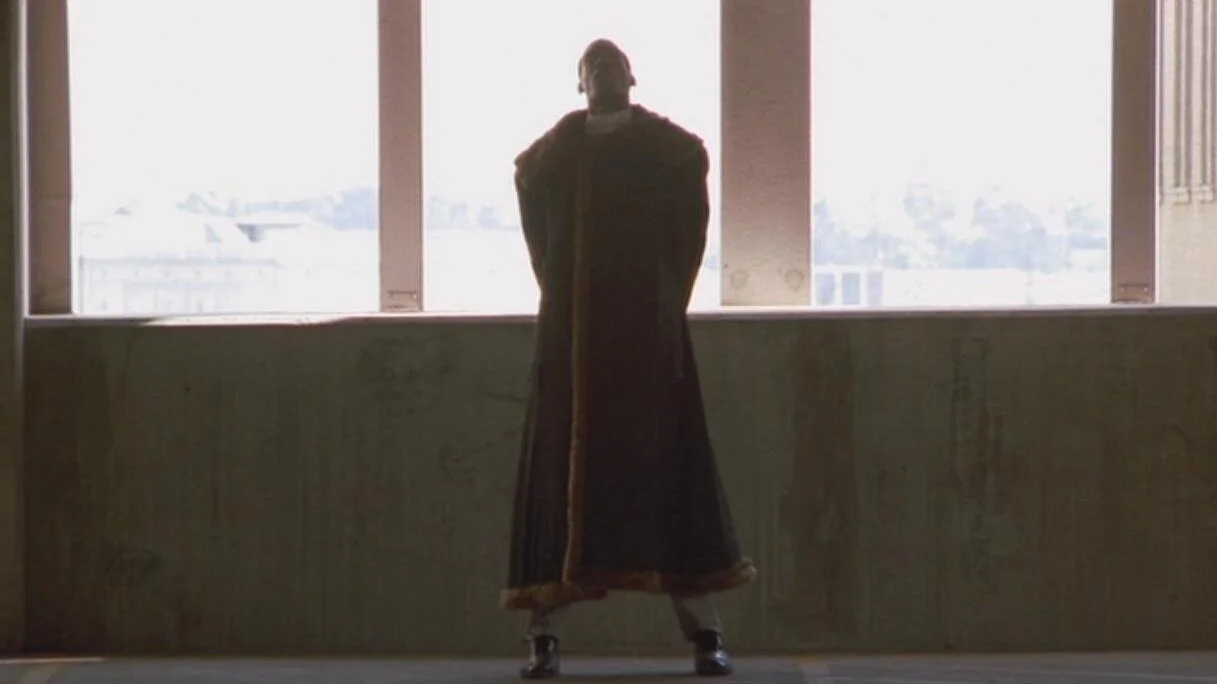
Helen doesn’t get much of a chance to breathe easily after the attack, as soon the terrifying specter of Candyman emerges in a parking garage. He hypnotizes Helen and basically tells her that he must spill blood to affirm the legend. It seems Helen’s work on her research paper has people in the area starting to question their belief in such a myth. Candyman is now out to prove them wrong.
It starts with a blood-soaked scene where Helen wakes up in where a dog is murdered and a baby is missing. Another murder soon occurs, one that hits Helen close to home, and our protagonist is soon taken into psychiatric care.
In perhaps one of the greatest scenes a kid has ever seen, I remember starting slack-jawed at the television screen when Helen summons Candyman during her psychiatric stay. Her psychiatrist doesn’t return for the sequel, if you catch my drift.
Ultimately, Helen is faced with an ultimatum- be Candyman’s ultimate victim, all in the name of tragic love lost buried beneath a nation’s history of racism and violence, or a young child dies. Helen, believing that she can trust the hook-wielding phantom who is terrorizing the entire city, fights Candyman after he refuses to give up the baby.
The film largely plays out like a gritty police procedural mixed with a dark, violent soap opera that sees Helen and Candyman ultimately face off in a pyre on the Cabrini-Green property.
Every move Rose made during the filming of Candyman was calculated. He had no intention of making this an exploitation film and he wanted to make sure to highlight the injustices and heart ache that the people who lived in this scenario experienced every day. Rose refused to play up drug use or gang violence in the film, preferring to focus on Helen’s drive for answers and the mythos that affected an entire community.
The director insisted on authenticity with this film, thus a good portion of the movie was filmed on-location in Cabrini-Green, during a three-day shoot that included a large police presence for security.

What makes the movie work so well are, really, two things.
First, the landscape of the film. The looming project buildings juxtaposed with claustrophobic car garages and dimly lit halls set the nerves on edge before viewers are even introduced to the phantom with a hook for a hand. One of my favorite scenes in horror history is Helen navigating her way through ruined apartments and the depths of Cabrini-Green, ultimately climbing out of a terrifying mural that could be seen as Helen being reborn into the world of the Candyman. The graffiti-smeared walls, the concrete walkways, and the echoes of the buildings make audiences feel as if they are stuck in a maze of anxiety and oppression that generations of Americans have been forced to live through.
Secondly, of course, we have the incredible performances by both Virginia Madsen, has protagonist Helen Lyle, and Tony Todd in the role of the iconic Candyman.
Todd was fiercely determined to get the role- horror audiences hadn’t seen a black icon of the genre since Duane Jones in 1968’s Night of the Living Dead. It should come as no surprise that Todd regularly acknowledged Jones as a hero of cinema and someone he looked up to.
Ever the professional, Todd’s experience as a stage actor and his credits prior to the film helped earn him the role. The actor also negotiated a hefty bonus for every bee sting he suffered during the filming. Todd once famously stated, “Everything that worth making involves pain.”
The iconic figure of Candyman was, in almost every way, molded and perfected by Mr. Todd himself. The backstory, the heart, the anger. Todd didn’t just play the role, he lived the role when the cameras went live. Todd stated multiple times throughout the years that he was intent on developing a poetic, tragic and very real human behind the blood-soaked hook and beehive ribcage. Todd exuded a sexual dominance as the Candyman, and it should come as no surprise that two characters he acknowledged as inspiration for the role are the classic horror monsters Dracula and The Phantom of the Opera.
Madsen credits Candyman as the role that changed her life. As friends of director Rose and his wife, Madsen ultimately got the role when Rose’s wife tapped out due to being pregnant. She went on to create a fiercely independent and determined protagonist and Madsen relished the opportunity to play a “real leading lady”.
Helen Lyle, much like Clarice Starling in The Silence of the Lambs, was a woman in a man’s world. When her educational drive detoured into something darker and more sinister, she is rarely taken seriously by the men in the film, most notably her putz of a lover and her slimy therapist. Lyle, however, remains hellbent on figuring out exactly what is going on in the projects and doesn’t back down, even when she comes face-to-face with the notorious boogeyman.

This movie is simply too beloved by me, too amazing and far too wild to spoil. If you’ve never seen this film, I highly suggest you do so immediately. Feel free to take a PTO Day, if necessary.
The love story at the core of this film plays out much like the stereotypical Dracula storyline, but Candyman tells it so much more bluntly, with a brutality that is hard to stomach at times. Tony Todd, forever the Candyman, calls Candyman his “own personal Phantom of the Opera.”
Todd, of course, made the titular character all his own. It’s truly impossible to consider anyone else in the trench coat with a rib cage full of bees. He played the character as just that- an individual, with a back story, with feelings, with pain, with genuine ferocity. He may have been a villain in the eyes of the Cabrini Green victims he stalked and the Hollywood big shots who licked their chops at the money the film would bring in, but the story of the Candyman was far more than a simple slasher film.
Is it even a real slasher film? I consider it to be part slasher, part ghost story, done in a beautifully poetic way that would have failed without Todd and director Bernard Rose at the helm.

The movie made its debut at the 1992 Toronto International Film Festival and went on to be released in the States on October 16, 1992. Box office numbers were impressive, hitting $25.7 million.
The original film brought to light a new perspective in horror, one that was, and still is, woefully underrepresented in the genre. While the film and its production has it’s warts, it deserves to be celebrated as one of the best horror films of its time.
Following the success of the original production, a sequel was released in 1995, and the third installment was (regretfully) released in 1999. A “spiritual sequel” was released in 2021, directed by Nia DeCosta, and most would consider that to be the best follow-up of the trio.
Will we get more visits from the Candyman at some point? Following Todd’s passing in 2024, I truly hope the mythology has ended- unless we get the sequel all Candyman fans have probably wanted to see since the first time they watched the original. If you haven’t seen the movie, I won’t spoil it here.
In late 2024, shortly after the stunning and heartbreaking news of Mr. Todd’s passing, Helen Lyle herself, Virginia Madsen, acknowledged plans for a prequel that would allow CGI to help tell the story of Daniel Robitaille before the heinous crimes that took his life and love away from him.
Whether that ever comes to fruition or not, we will always have Tony Todd and the film that brought Clive Barker’s blood-soaked lore to the big screen in spectacular fashion. For that, we can be forever grateful.

Leave a Reply