
Growing up, music was always playing in our house. Whether it was during Saturday morning house cleanings or down in the basement while my father worked out, I was raised in an eclectic musical environment. A boom box stereo system sat atop a hutch in our living room, complete with (gasp!) a 5-disc CD player. If Mom were in control of the music on a Saturday while Dad was at work, we were sure to be serenaded with the likes of En Vogue, Prince, Stevie Wonder and Missy Elliott in the later years. If I descended into the basement to play video games while Dad worked out, I was surely listening to a Led Zeppelin album during my stay.
After an introduction to the radio-friendly hits, I started developing an appreciation for the band’s entire catalog. Dad preferred the heavy stuff while working out, of course, and I soon found myself digging into the deep cuts on my own.
In high school, Led Zeppelin wasn’t just my favorite band, they were literally all I listened to during my junior year in high school. The band had a jam for practically any occasion, and I supplemented the studio hits with a mountain of bootlegs I snagged off a free-sharing message board back in 2004. It was awesome.
As my passion for the band’s music grew, my interest in the behind-the-scenes stories was satiated by Richard Cole’s salacious book and, most importantly, by a gentleman named Dave Lewis, who I followed online. Lewis published a fantastic book in 1991 called Led Zeppelin: A Celebration, and I scored a copy while spending birthday money when I was sixteen years old. I read that book from cover to cover and still have my well-worn copy that sits proudly on the top shelf of my bookcase.
Through Mr. Lewis and his close relationship with the band, I learned what inspired the band and what made them tick. For a relatively innocent teenager who just thought the band was awesome, I was fascinated to learn how deep into the occult guitarist Jimmy Page had delved and how much singer Robert Plant was inspired by folklore and J.R.R Tolkien’s seminal The Lord of the Rings literature.
I’ve forgotten more about the band than most people will ever probably care to learn at this point in my life, some thirty years after falling in love with their music. The band’s interweaving of classic literature and the dark arts into their music is a topic I could talk about for hours on end. Alas, this is but a brief history of the topic.
If you’re ready to get the Led out with me, grab your headphones, sit back and let the music be your master.

When it comes to Led Zeppelin and their Tolkien-inspired work, it’s easy to find. It’s certainly not as if lead song writer Robert Plant or the band shied away from the subject. Three songs directly reference Plant’s beloved literature and a fourth has been the subject of debate amongst Zepheads for quite some time.
On Led Zeppelin II, released in October of 1969, the band stretched their musical wings and began to celebrate the music that brought them together. While their debut album was almost entirely a heavy blue and rock-driven tour de force, their sophomore album introduced acoustic guitar and a softer side to a band that would ultimately help reshape the rock world over the following decade.
Nestled cozily on Side Two, right in between a shrieking jam out and a monumental drum solo track, sits “Ramble On”.
The track is the story of a young man’s love slowly fading for his current gal while he pines for a woman he knows he’s meant to be with, the queen of all his dreams. Plant alludes to this woman being someone from his past, back perhaps when love was more innocent and the world offered a “magic that filled the air”. This is where one of Tolkien’s most famous characters makes his appearance in the Zeppelin catalog.
“Mine’s a tale that can’t be told
My freedom I hold dear
How years ago in days of old
When magic filled the air
‘T was in the darkest depths of Mordor
I met a girl so fair
But Gollum, and the evil one
Crept up and slipped away with her
Her, her, yeah
Ain’t nothing I can do, no”
Led Zeppelin IV, arguably the band’s most mysterious album and certainly the one released at the peak of Zeppelin’s power in 1971, brought audiences the band’s most Tolkien-infused collection, starting with “The Battle of Evermore” on Side A.
“The Battle of Evermore” is Zeppelin’s most traditional Tolkien-inspired song, per se. The song features no percussion and is played on mandolin and acoustic guitar by Page. This is the only Zeppelin song that features backing vocals done by a non-band member. In this instance, it’s folk icon Sandy Denny, who spins the tale with Plant beautifully as the duo sings about the Queen of Light (Galadriel, a key character in the book series) and ring wraiths riding in black (think the four horsemen of the apocalypse-style havoc).
“The Queen of Light took her bow
And then she turned to go”
“The pain of war cannot exceed the woe of aftermath
The drums will shake the castle wall
The Ringwraiths ride in black, ride on”
The song also references Avalon (or Avallónë), a seaport in Tolkien mythology, as well as “magic runes writ in gold to bring the balance back”.
“Oh, throw down your plow and hoe
Rest not to lock your homes
Side by side we wait the might
Of the darkest of them all
I hear the horses’ thunder down in the valley below
I’m waiting for the angels of Avalon, waiting for the eastern glow”

Side B of one of the most famous rock albums of all time asks us to do the “Misty Mountain Hop”. The song takes its name directly from the fabled Misty Mountains in the Lord of the Rings series. This particular stretch of terrain is nearly impossible to pass, apart from a few passes that one would be so lucky to find. If a traveler isn’t turned back by their own dread of the daunting peaks, surely the countless monsters and beasts that call the mountains home can do the trick.
In the novel, the crossing of these mountains play a pivotal role in the arch of the story. In the world of Led Zeppelin, Plant tells a loose interpretation of the Tolkien sequence backed by a tasty riff by Page and thunderous percussion by John Bonham. Plant tells of ‘An Unexpected Party’, which almost directly recounts the first chapter of Tolkien’s The Hobbit, as several unknown dwarves and even Gandalf the Grey himself, settle into Bilbo Baggins’ home to prepare for the start of their epic journey.
“Well, you know, they asked us to stay for tea and have some fun
Oh, oh, oh
He said that his friends would all drop by, ooh”
“So I’m packing my bags for the Misty Mountains
Where the spirits go now
Over the hills where the spirits fly, ooh”
The song, of course, has also been widely seen as a tale of the thousands of concert goers who typically camped out for their chance to see the mighty Zeppelin in person, almost all of them assuredly enjoying their own misty mountain hop.
“Walking in the park just the other day, baby
What do you, what do you think I saw?
Crowds of people sitting on the grass with flowers in their hair said
Hey, boy, do you wanna score?
And you know how it is?
I really don’t know what time it was
Whoa, oh, oh
So I asked them if I could stay a while”
The quickest nod to Tolkien literature comes at the end of Zeppelin’s rollicking folk song, “Bron-Y-Aur Stomp”. In the last sequence of the jam, Plant proclaims the following:
“When you’re old and your eyes are dim
There ain’t no old Shep gonna happen again
We’ll still go walking down country lane
I’ll sing the same old song, hear me call your name
Strider!”
Plant had a dog named Strider at the time, and while the song ultimately boils down to an homage to man’s best friend, the name is undoubtedly a nod to one of Tolkien’s most well-known protagonists, Aragorn. The character is first introduced in Strider in the books. Strider/Aragorn is a loyal and fearless leader, certainly a name that fits perfectly with a family sheep dog.

As Tolkien would have been nearly eighty years old when Led Zeppelin IV debuted, there isn’t much known about whether Tolkien even was aware of the acknowledgements of his work in Led Zeppelin’s music, but Plant didn’t shy away from acknowledging the influence.
As of this writing, Plant was asked about his Tolkien fandom a few months back while a guest on The Late Show with Stephen Colbert.
Plant gave credit to his parents for introducing him to Tolkien’s work as a young boy who grew up in the West Midlands. Plant himself was raised with a deep appreciation of the cultures of his homeland. He even went as far as to state he was a member of a prestigious writing group called The Inklings, of which Tolkien and fellow renowned fantasy author C.S. Lewis were members.
The legendary frontman proclaimed Tolkien to be a “master”, rightfully so, and a man who “opened the door to all that, sort of dark age meander of history”.

While Robert was spinning mystic tales of love, adventure and optimism, guitarist Jimmy Page’s interests were shrouded more in the darker shades of mystery.
Page had long been a student of the occult, at the very least a constant reader of “the wickedest man in the world” Aleister Crowley and used his Zeppelin fortune to purchase the famed haunted property known as the Boleskine House.
Boleskine House was reportedly the location where Crowley performed several dark magic rituals, namely invoking his guardian angel and summoning the twelve kings and dukes of Hell. This being a brief history of Led Zeppelin, mostly, I must simply suggest you uncross your eyes after reading that last sentence and do some wild rabbit hole diving on your own on this topic. At one point, there’s even been mention of the Loch Ness Monster itself is a demon summoned by Crowley during his time at the house.
Page owned the Boleskine House for twenty-two years, from 1970 to 1992. The property was in poor shape when Page purchased it and ultimately left much of the day-to-day work on the home to an assistant. Page thought the home would be a great location to write music and one can’t help but wonder how much of his knowledge of Crowley’s past (and previous ownership of the property) had to do with him selecting this particular property to add to his portfolio.
The assistant responsible for most of the daily work at the residence staunchly proclaimed himself to be a skeptic of the paranormal, but wholeheartedly insists he heard noises throughout the home, namely rumbling down hallways and small furniture moving about. Things reached a particularly terrifying crescendo one night when the man claimed to hear some sort of animal snorting and banging outside his bedroom door. The man has gone on record as saying, “whatever was there was pure evil”, and another associate claimed to be attacked by “some kind of devil” while visiting the residence.
Page didn’t spend much time at the residence himself, but he did put a decent amount of money into it to restore the famed property.

No stranger to dark properties, Page also had an affinity for the Victorian era Headley Grange. The sprawling former workhouse was repurposed into prime studio and rehearsal space for several bands, including Bad Company, Genesis and, of course, Led Zeppelin.
Parts of four Zeppelin albums were recorded at Headley Grange, including ‘Black Dog’ as a playful tribute to a roaming black dog found on site while the band was there. Do yourself a favor and check out the mythology behind black dogs in England as a harbinger of death. Fun stuff!
Perhaps the greatest song ever written in Headley Grange was Zeppelin’s masterpiece, ‘Stairway to Heaven’, which Plant reportedly wrote in less than a day while on the property. Then there’s ‘When the Levee Breaks’, which the band recorded with John Bonham’s drum set tucked tightly into a staircase of the property to achieve a bone-rattling percussive effect that was revolutionary for its time.
The location was widely considered haunted by band members, locals and paranormal investigators alike.

While ‘Black Dog’ was a fantastic rock song simply named after an eerie folk tale in English lore, and ‘Stairway To Heaven’ is considered to be more about the excesses of life and longing to find your place, the next and final song featured in this piece is perhaps the darkest Zeppelin song of them all.
Released in spring of 1973 on Zeppelin’s fifth album, Houses of the Holy, ‘No Quarter’ is a song you simply must experience.
I highly suggest listening to it in a darkened room with your favorite beverage or smoking apparatus in hand.
The song is closer to a Pink Floyd song than a perceived Zeppelin jam, dark and brooding. Widely considered a tale of Vikings or another brutal military group fighting it’s way through a vicious winter storm while also staving off possible supernatural terrors, ‘No Quarter’ is about as beautifully chilling a song as I can think of.
Bassist John Paul Jones sits behind the keyboards on this one, pulling the listener through a story about walking side by side with death and feeling as if the hounds of doom are right behind us.
“Close the door, put out the light
You know they won’t be home tonight
The snow falls hard and don’t you know?
The winds of Thor are blowing cold
They’re wearing steel that’s bright and true
They carry news that must get through
They choose the path where no-one goes
They hold no quarter
They hold no quarter”
“Walking side by side with death
The devil mocks their every step, ooh
The snow drives back the foot that’s slow
The dogs of doom are howling more”

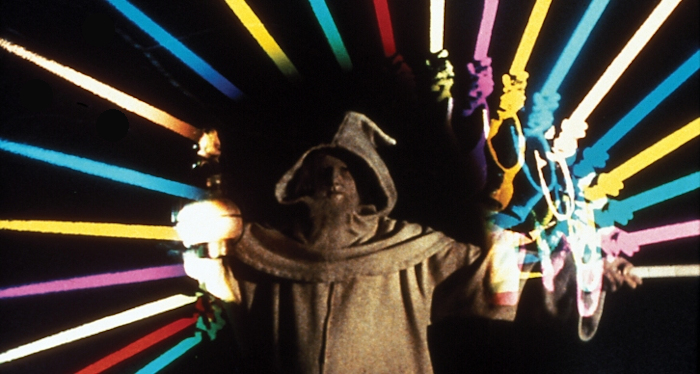
Fellow dark arts practitioner and lauded author William S. Burroughs put together a fantastic piece for Crawdaddy magazine in 1975, in which he attends a Led Zeppelin concert and then digs into a pretty deep dive with Page. Some of the more interesting topics discussed were “friends in common” the real estate agent who sold the Crowley residence to Page, UFO and pyramid expert John Michel and filmmaker Kenneth Anger, whose film ‘Lucifer Rising’ Page did the soundtrack work for.
Burroughs was a mysterious, if not enigmatic character, in his own right- oh, to be a fly on the wall for their chat. Both Burroughs and Page subscribed to the idea that we lived in a magical universe. Burroughs freely admitted he’d attempted to place curses upon people he believed wronged him. He dabbled in chaos magik in his later years.
Page and Burroughs discussed a World War II healing psychic, Burroughs’ trip up a column of light during a meditation seminar that he refers to as “the stairway to heaven” and Page even acknowledges that, as a band, Zeppelin had “a responsibility to the audience… we don’t want anything bad to happen… we don’t want to release anything we can’t handle”. Page held mass concentration, or trance-like states, in high regard and respected the power of music on a level that many probably wouldn’t even consider.
But back to magic. This article from 1975 has Page looking forward to “the day when you can get.. holograms” to use during concerts. He also references wanting to use the Van de Graaff Generator, which is a version of the massive electric towers used in the Universal Horror film Frankenstein from the 1930’s.
Page was fascinated by the idea of magic and the darker components that may come with it. However, in all of my studies on the band or the man himself, I’ve never found actual proof that this interest of his manifested in any other way but giving him a mysterious, probably even sexual, charge amongst concert goers and Zeppelin fans. Of course, Zeppelin certainly wasn’t the only band of the era intrigued by the art of magic, whether it be white or dark, and most of the stories and rumors can be chalked up as just that. The bands and members, of course, knew exactly what they were doing- paying heed to the almighty magic of this world, the dollar.
Led Zeppelin was the single biggest influence of my formative years, and I will forever hold those days’ worth of music listening near and dear to my heart. Through the mystic appreciation of Tolkien to the rumored darker influences of magik and astrology, I will not attribute the band’s excesses or the tragedy that befell the group to their hobbies or interests. Led Zeppelin soared higher than any band in their prime and gave listeners and scholars, alike, plenty to consider throughout their mythic run.
Do yourself a favor and forget the radio hits – I’d even go so far as to suggest you not feel obligated to listen to ‘Stairway to Heaven’ (all hate mail can be sent directly to my email address) – and check out some of the deeper jams in Zeppelin’s arsenal. ‘No Quarter’ and ‘The Battle of Evermore’, for sure. Do it quickly, before the hounds of doom come a’howlin’.


Leave a Reply